Unlimited Information.............


Mysore ಮೈಸೂರು

ಮೈಸೂರು 

360 Kannada Flash Version - Click to View 360 Higher Quality 360 Panorama - Kannada Version
360 Flash English Version - Click to View 360 Higher Quality 360 Panorama - English Version
Mysore (pronounced /maɪˈsɔər/ (
Mysore (pronounced /maɪˈsɔər/ (
Mysore is famous for the festivities that take place during the Dasara festival when the city receives a large number of tourists. Mysore also lends its name to the Mysore mallige, the Mysore style of painting, the sweet dish Mysore Pak, the Mysore Peta (a traditional silk turban) and the garment called the Mysore silk saree. In an exercise carried out by the Urban Development Ministry under the national urban sanitation policy, Mysore was rated the second cleanest city in India in 2010 and the cleanest in Karnataka.

History
[edit] Wodeyar
Until 1947, Mysore was the capital of the Kingdom of Mysore and was ruled by the Wodeyar dynasty, except for a 40-year era in the 18th century when Haidar Ali and Tipu Sultan were the de facto rulers of the province. The Wodeyars were patrons of art and culture and contributed significantly to the cultural growth of the city, which has led to Mysore earning the sobriquet Cultural capital of Karnataka.
According to Hindu mythology, the area around Mysore was known as Mahishūru or Mahishapuram. It was ruled by a demon, Mahishasura.[4] The demon was killed by the Goddess Chamundeshwari, whose temple is situated atop the Chamundi Hills. Mahishūru later became Mahisūru and finally came to be called Maisūru, its present name in the Kannada language.[5] The anglicised form of the name is Mysore.[4] In December 2005, the Government of Karnataka announced its intention to change the English name of the city to Mysuru.[6] This has been approved by the Government of India but the necessary formalities to incorporate the name change are yet to be completed.[7]
 Chamaraja Wadiyar X ruling Maharaja of Mysore between 1881 and 1894.
 The region where Mysore city stands now was known as Puragere till the 15th century.[8] The Mahishūru Fort was constructed in 1524 by Chamaraja Wodeyar III (1513–1553), who later passed on the dominion of Puragere to his son Chamaraja Wodeyar IV (1572–1576). Since the 16th century, the name of Mahishūru (later Mysore and changed again to Mysuru by the Government of Karnataka on November 1, 2007) has been commonly used to denote the city.[8] During the rule of the Vijayanagara Empire, the Mysore Kingdom under Wodeyars, served as a feudatory. Mysore was the center of the Wodeyar administration till 1610 when Raja Wodeyar ousted the Vijayanagara governor at nearby Srirangapatna and made it his capital. With the demise of the Vijayanagara Empire in 1565, the Mysore Kingdom gradually achieved independence and became a sovereign state by the time of King Narasaraja Wodeyar (1637).[9]
After Tipu Sultan's death in the Fourth Anglo-Mysore War in 1799, the Kingdom was distributed by the British to their allies of the Fourth Mysore war, the Marhata, Nizam, and State of Travancore, while the rule of Mysore city was retained by the British who built the Government House (completed 1805). The Government House is now used by the Government of Karnataka as a State Guest House. The existing town of Nazarabad was demolished to remove any traces of Tipu's rule. The capital of the kingdom was moved back to Mysore.[10][11] The British administration was assisted locally by Diwan Purnaiah, in return for his assistance in the defeat of the Mysore Army. Purnaiah is credited with improvements to Mysore's public works.[10]
In 1831, Mysore lost its status as the administrative centre of the kingdom when Mark Cubbon, the British commissioner, moved the capital to Bangalore.[12] However it regained this status in 1881, when the British handed power back to the Wodeyars.[13] The city remained the capital of the Wodeyars till 1947, with Mysore Palace as the centre of administration.

The Mysore municipality was established in 1888 and the city was divided into eight wards.[14] In 1897, an outbreak of bubonic plague killed nearly half of the population of the city.[15] With the establishment of the City Improvement Trust Board (CITB) in 1903, Mysore became one of the first cities in Asia to undertake a planned development of the city.[16] When the Quit India Movement was launched in the early 1940s, Mysore city also played a part in it. Leaders of the independence movement like H. C. Dasappa and Sahukar Channayya were at the forefront during the agitations.[17] The Maharaja's College hostel was the nerve centre from where the movement was controlled in the Mysore district and the Subbarayana Kere ground was an important location for public demonstrations.
After Indian independence, Mysore city remained as a part of the Mysore State. Jayachamarajendra Wodeyar, the then king of Mysore, was allowed to retain his titles and was nominated as the Rajapramukh of the state. He died in September 1974 and was cremated in Mysore city.[18] Over the years, Mysore has become well known as a centre for tourism and the city has remained largely peaceful, except for occasional riots related to the Kaveri river water dispute.[19] Some of the events that took place in Mysore and made national headlines were the fire at Premier Studios that claimed the lives of many people, and the sudden deaths of many animals at the Mysore Zoo.[20][21][22]
[edit] Geography
| Mysore | ||||||||||||||||||||||||||||||||||||||||||||||||||||||||||||
|---|---|---|---|---|---|---|---|---|---|---|---|---|---|---|---|---|---|---|---|---|---|---|---|---|---|---|---|---|---|---|---|---|---|---|---|---|---|---|---|---|---|---|---|---|---|---|---|---|---|---|---|---|---|---|---|---|---|---|---|---|
| Climate chart (explanation) | ||||||||||||||||||||||||||||||||||||||||||||||||||||||||||||
| ||||||||||||||||||||||||||||||||||||||||||||||||||||||||||||
| ||||||||||||||||||||||||||||||||||||||||||||||||||||||||||||

[edit] Climate
Mysore is located at 12.30°N 76.65°E and has an average altitude of 770 metres (2,526 ft).[23] It is situated in the southern region of the state of Karnataka, at the base of the Chamundi Hills and spreads across an area of 128.42 km2 (50 sq mi).[2] The summer season is from March to June, followed by the monsoon season from July to November and the winter season from December to February.[23] The highest temperature recorded in Mysore was 38.5 °C (101 °F) on May 4, 2006, and in winter, temperatures as low as 9.6 °C (49 °F) have been recorded.[24][25] The average annual rainfall received by the city is 798.2 mm (31 in).[2]:p.04 Though Mysore is situated in the relatively safe seismic zone II, earthquakes of magnitude greater than 4.5 on the Richter scale have been recorded in the vicinity of the city.[26][27]


Mysore has several lakes, prominent among are the Kukkarahalli, Karanji and Lingambudhi lakes. In 2001, percentages of total land area in Mysore city occupied by residences, roads, park and open spaces, industries, public property, commercial establishments, agriculture and bodies of water were 39.9%, 16.1%, 13.74%, 13.48%, 8.96%, 3.02%, 2.27% and 2.02% respectively.[28]
Mysore is situated between the rivers Kaveri and Kabini, which are a source of drinking water to the city.[28]:p.53 The city got its first piped water supply when the Belagola project was commissioned in 1896.[29] At present, water is supplied to Mysore in the volume of 42.5 million gallons per day from three projects; Hongally (III Stages), Belagola and Melapur and this reaches 85% of households. Mysore sometimes faces water crises, mainly during the months of summer and in years of deficient rainfall.[30] The city has had an underground drainage system since 1904 and the entire sewage from the city drains into four valleys; Kesare, Malalavadi, Dalavai and Belavatha.[28]:p.56
[edit] Civic administration

The civic administration of the city is managed by the Mysore City Corporation, which was established as a municipality in 1888 and later converted into a corporation in 1977. The corporation oversees the engineering works, health, sanitation, water supply, administration and taxation in the city. It is headed by a mayor who is assisted by commissioners and council members.[28]:p.43 The city is divided into 65 wards and the council members (also known as corporators) are elected by the citizens of Mysore every five years.[31] The council members in turn elect the mayor. The annual budget of the Corporation for the year 2007–2008 was Rs. 11,443.89 lakh (US$28.6 million).[32]
The growth and expansion of the city is managed by the Mysore Urban Development Authority (MUDA), which is headed by a commissioner. Its activities include developing new layouts and roads, town planning and land acquisition.[33] One of the major projects undertaken by MUDA is the creation of an Outer Ring Road in Mysore, which is expected to ease traffic congestion.[34] On the contrary, MUDA has faced criticism from citizens of Mysore for its inability to ensure that sufficient sites are allotted to house residents of the city.[35] The electrical supply to the city is managed by the Chamundeshwari Electricity Supply Corporation.[36]
The citizens of Mysore elect four representatives to the Legislative assembly of Karnataka through the constituencies of Chamaraja, Krishnaraja, Narasimharaja and Chamundeshwari.[37] Mysore city, being a part of the larger Mysore Lok Sabha constituency, also elects one member to the Lok Sabha, the lower house of the Indian Parliament. The politics in the city is dominated by three political parties: the Indian National Congress (INC); the Bharatiya Janata Party (BJP); and the Janata Dal (Secular) (JDS).[37]
[edit] Demographics

According to the census of 2001, Mysore city had a total population of 799,228 with 406,363 males and 392,865 females, making it the second largest city in Karnataka.[1][38] The gender ratio of the city is 967 females to every 1000 males and the population density is 6223.55 persons per km2. Among the population, 76.8% are Hindus, 19% are Muslims, 2.8% are Christians and the remaining belong to other religions.[39] The city's population crossed the 100,000 mark in the census of 1931 and has seen a population growth of 20.5% in the decade 1991–2001. The literacy rate of the city is 82.8%, which is much higher than the state's average of 67%.[28]:p.32 Kannada is the most widely spoken language in the city. Nineteen percent of the population in Mysore live below the poverty line and 9.0% of the population live in slums. Though 35.7% of the population in the urban areas of Karnataka are workers, only 33.3% of the population in Mysore city belong to the working class.[38] People belonging to Scheduled Castes and Scheduled tribes contribute to 15.1% of the population.[38] Mysore has seen a spurt in crime with 805 incidents of crime reported in 2005, higher than the 510 incidents of crime reported in 2003.[40]
The residents of the city are known as Mysoreans in English and Mysoorinavaru in Kannada. The ongoing dispute between the states of Karnataka and Tamil Nadu over the sharing of the Kaveri River water, has frequent repercussions in the city leading to minor altercations and demonstrations.[41] Growth in the Information Technology industry in Mysore has led to a change in the demographic profile of the city and has been a cause of concern for some citizens of the city.[42]
[edit] Business and economy

While tourism is the major industry in Mysore, the growth of information technology related industry in the first decade of the 21st century has resulted in the city emerging as the Second largest software exporter in the state of Karnataka, next to Bangalore. Mysore is also the location of Mysore University, whose alumni include Kuvempu, Gopalakrishna Adiga, S. L. Bhyrappa, U. R. Ananthamurthy and N.R. Narayana Murthy. The All India Radio, the premier radio broadcasting arm of the Government of India had its beginnings here.
Traditionally, Mysore has been home to industries such as weaving, sandalwood carving, bronzework, and the production of lime and salt.[43] The planned industrial growth of the city and the state was first envisaged in the Mysore economic conference, held in 1911.[43][44] This led to the establishment of industries such as the Mysore Sandalwood Oil Factory in 1917 and the Sri Krishnarajendra Mills in 1920.[45][46]
In a survey conducted in 2001 by Business Today, the business arm of India Today, Mysore was ranked the fifth-best city in India in which to conduct business and the second-cleanest city in India, where only Chandigarh ranked cleaner.[47] Mysore has emerged as the hub of the tourism industry in Karnataka, attracting about 2.5 million tourists in 2006.[48] National Parks 40–60 miles to the south include Bandipur National Park and Mudumalai National Park sanctuary for gaur, chital, elephants as well as Bengal Tigers, Indian Leopards and other threatened species.
For the industrial development of the city, the Karnataka Industrial Areas Development Board (KIADB) has established four industrial areas in and around Mysore and are located in Belagola, Belawadi, Hebbal (Electronic City) and Hootagalli areas.[49] The major industries in Mysore include BEML, J. K. Tyres, Wipro, SPI, Falcon Tyres, L & T, Theorem India pvt Ltd and Infosys.[41]

Since 2003, information technology companies have been creating bases in Mysore, with the city contributing Rs. 1100 crores (US$220 million) to Karnataka's IT exports in the financial year 2007–2008.[50] Infosys has established one of the largest technical training centres in the world and Wipro has established its Global Service Management Center (GSMC) at Mysore.[51][52] Non-IT related services have been outsourced from other countries to companies in Mysore.[53]
The industrial sector in the city experienced setbacks when the automobile manufacturer Ideal Jawa and the Sri Krishnarajendra Mills closed their operations.[54] Revival efforts, such as the takeover of the Krishnarajendra Mills by the Atlantic Spinning and Weaving Mills Ltd. have been made, but these attempts have run into other problems.[55]
[edit] Education

Before the advent of the English system of education in Mysore, agraharas imparted the Vedic system of education to Hindus and madrasas served as centres of learning for Muslims.[56] Modern education saw its beginning in Mysore when a free English school was established in 1833.[57] In 1854, the East India Company promulgated the Halifax Dispatch which looked at organising education based on the Western model within the princely state of Mysore.[58] The first college to be set up for higher education in Mysore was the Maharajas College, which was founded in 1864.[57]:p.50 In 1868, the Mysore state decided to establish hobli schools to extend education to the masses.[59] Under this scheme, a school was established in each hobli (a locality within the city) and the education was free. This led to the establishment of a normal school in Mysore which imparted coaching to teachers who were meant to teach in the hobli schools. In 1881, a high school exclusively for girls was established and this was later converted into the Maharanis Women's College.[60] In 1892, the Industrial School, the first institute to impart technical education in the city was started and this was followed by the Chamarajendra Technical Institute in 1913.[61] While the modern system of education was making inroads in the city, colleges such as the Mysore Sanskrit college, which was established in 1876, continued to provide Vedic education.[62]
The education system in Mysore received further impetus when the University of Mysore was established in 1916.[63] This was the sixth university to be established in India and first in Karnataka.[63] It was named Manasagangotri ("fountainhead of the Ganges of the mind") by the poet laureate, Kuvempu. The university caters to the districts of Mysore, Mandya, Hassan and Chamarajanagar in Karnataka. About 127 colleges (having a total student population of 53,000) are affiliated with the university. Mysore University is the only university in the state of Karnataka to get a grade of A+ from the National Assessment and Accreditation Council of India.[64]
Education in the field of engineering was started in Mysore with the establishment of the National Institute of Engineering in 1946 the Second Oldest Engineering College in the State.[65] Medical education started in 1930 when the Mysore Medical College was transferred from Bangalore to Mysore. Other institutes in the city include the Central Food and Technological Research Institute, the Central Institute of Indian Languages and the All India Institute of Speech and Hearing. Prestigious B-Schools such as SDMIMD,JSS Center for Management studies, Bhavan's Institute of Management are located in Mysore city.
[edit] Art and culture

Known as the cultural capital of Karnataka,[66] Mysore is well known for the festivities that take place during the period of Dasara, the state festival of Karnataka. The Dasara festivities, which are celebrated over a ten-day period, were first introduced by King Raja Wodeyar I in 1610.[67] On the ninth day of Dasara, called Mahanavami, the royal sword is worshipped and is taken on a procession comprising decorated elephants, camels and horses.[67] On the tenth day, called Vijayadashami, the traditional Dasara procession (locally known as Jumboo Savari) is held on the streets of Mysore city. An image of the Goddess Chamundeshwari is placed on a golden mantapa on the back of a decorated elephant and taken on a procession, accompanied by tableaux, dance groups, music bands, decorated elephants, horses and camels.[67] The procession starts from the Mysore Palace and culminates at a place called Bannimantapa where the banni tree (Prosopis spicigera) is worshipped.[67] The Dasara festivities culminate on the night of Vijayadashami with a torchlight parade (locally known as Panjina Kavayatthu).[67]

Mysore is called the City of Palaces because of the number of palaces situated in the city, including Amba Vilas popularly known as Mysore Palace, Jaganmohana Palace which has now been converted into an art gallery, Rajendra Vilas also known as the summer palace, situated in the Chamundi Hills, Lalitha Mahal which has now been converted into a hotel and Jayalakshmi Vilas, which is now on the University of Mysore premises.[68] The main palace of Mysore burned down in 1897, and the present-day structure was built on the same site. Externally, Amba Vilas palace exhibits an Indo-Saracenic architecture style though the interior is distinctly Hoysala style of architecture in nature.[69] Even though the Government of Karnataka now maintains the Mysore palace, a small portion of the palace has been allocated for the erstwhile Royal family to live in. The Jayalakshmi Vilas Mansion was constructed by Sri Chamaraja Wodeyar for his daughter Jayalakshammanni. It is now a museum dedicated to folk culture. A new gallery is being added for artifacts and collections of the Wodeyars of Mysore.[70]
The Mysore painting style is an offshoot of the Vijayanagar school of painting. King Raja Wodeyar (1578–1617 CE) is credited with having been the patron for this style of painting.[71] The distinctive feature of these paintings is the gesso work in which gold foils are pasted appropriately on the painting.[71]:p.03

Mysore is the location of the International Ganjifa Research Centre, which is involved in the research of the ancient card game Ganjifa and the art associated with it.[72] Mysore is known for rosewood inlay work, with an estimated 4,000 craftsmen involved in this art.[73] The city lends its name to the Mysore silk saree, a ladies' garment, made with pure silk and gold zari.[74] Mysore has institutes such as the Chamarajendra Academy of Visual Arts (CAVA), which offers education in visual art forms like painting, graphics, sculpture, applied art, photography, photo-journalism and art history. The theatre repertory Rangayana conducts plays and offers certificate courses on subjects related to theatre.[75][76]
Notable Kannada littérateurs Kuvempu, Gopalakrishna Adiga and U. R. Ananthamurthy have had a long association with Mysore, partly because they had their education there and also served as professors at the Mysore University.[77] The famous English novelist and creator of Malgudi, R. K. Narayan and his brother and cartoonist R. K. Laxman spent much of their life in Mysore.[77]
Transport

Air
Beginning in October 2010, the Mysore Airport (also known as the Mandakalli Airport due to its location[78]) provides flights from Bangalore and Chennai through Kingfisher Airlines.[79]
Railways
Mysore Railway Station has three railway lines that connect it to the cities of Bangalore, Hassan and Chamarajanagar. The first railway line established in the city was the Bangalore-Mysore Junction metre gauge line, which was commissioned in 1882.[80] However, all railway lines that serve the city are single track ones which impede faster connectivity to the city. Though there are plans to double at least the Bangalore–Mysore track, the project is yet to be completed.[81] All trains that connect to Mysore are operated by Indian Railways and the fastest train to serve the city is the Shatabdi Express. The new Railway Project will improve the development prospects of Mysore.
[edit] Roadways
Mysore is connected by National Highway NH-212 to the state border town of Gundlupet which then forks into the states of Kerala and Tamil Nadu.[82] The high traffic State Highway 17 which connects Mysore to Bangalore was, in 2006, upgraded to a four-lane highway which has reduced the travel time between the two cities.[83] A project was planned in 1994 to construct a new expressway to connect the cities of Bangalore and Mysore. But this has run into numerous legal hurdles and the work has yet to be completed.[84] Other main roads are State Highways 33 and 88, which connect Mysore to H D Kote and Madikeri respectively.[85]
The Karnataka State Road Transport Corporation (KSRTC) and other private agencies operate buses from Mysore. A new division of KSRTC called Mysore City Transport Corporation (MCTC) has been proposed to be formed. Within the city, buses offer a cheap and popular means of transport. Auto-rickshaws are also available for intra-city commute. Tongas are popular in Mysore.[86]
Media
Newspaper publishing in Mysore started in 1859 when Bhashyam Bhashyacharya began publishing a weekly newspaper in Kannada, called the Mysooru Vrittanta Bodhini.[87] This was followed by other weekly newspapers such as the Karnataka Prakashika (1865), the Mysore Gazette (1866) and the Vrittanta Patrike (1887).[87] One of the well-known publishers in Mysore during the Wodeyar rule was M Venkatakrishnaiya, who is called the father of Kannada journalism. He started news magazines such as Sampadabhyudaya, Vidyaadaayini, the Mysore Patriot and Saadhvi.[88] Currently, popular newspapers with Mysore editions include the English-written Times of India and Deccan Herald, and the Kannada-written Prajavani and Vijaya Karnataka. The Star of Mysore, Andolana and Mysooru Mithra and other local newspapers are also published in the city and these carry news mostly related to Mysore city and its surroundings.[89] Sudharma, the only daily newspaper in the Sanskrit language, is also published from Mysore.[90]
Mysore was the location of the first private radio broadcasting station in India when Akashavani (which literally means voice from the sky) was established in the city on September 10, 1935. The radio station was established by M.V. Gopalaswamy, a professor of psychology at his house in the Vontikoppal area of Mysore, using a 50-watt transmitter.[91][92] The station was taken over by the princely state of Mysore in 1941 and was moved to Bangalore in 1955. In 1957, the name Akashvani was chosen as the official name of the All India Radio (AIR), the radio broadcaster of the Government of India. The AIR station at Mysore broadcasts an FM radio channel at 100.6 MHz,[93] and Gyan Vani broadcasts on 105.2.[94] BIG 92.7 became the first private FM channel to broadcast in Mysore when it started operations on November 1, 2007.[95] S FM 93.5 also launched its radio station there in April 2008.
Mysore city started receiving television broadcasts in the early 1980s when Doordarshan started beaming its national channel all over India. This was the only channel available for Mysoreans till Star TV started beaming satellite channels in 1991. Direct to home channels are now available in Mysore.[96]
Sports

The Wodeyar kings of Mysore were patrons of various games and sports. King Krishnaraja Wodeyar III had a passion for indoor games. He invented new board games and popularised the ganjifa card game.[97] The sport of traditional wrestling has a history dating back to the 16th century in Mysore.[98] This tradition still continues and the wrestling competition held in Mysore during the Dasara celebrations attracts wrestlers from all over India. An annual sports meet comprising of various events is also organised in Mysore during the Dasara season.[99]
In 1997, the city along with Bangalore co-hosted its biggest sports event ever, the National Games of India. Mysore was the venue for six events: archery, gymnastics, equestrian events, handball, table tennis and wrestling.[100] Cricket is by far the most popular sport in Mysore.[101] The city has four established cricket grounds, but is yet to host an international cricket match.[102] Javagal Srinath, who represented India for several years as its fast bowling spearhead, hails from Mysore.[103] Other prominent sportsmen from the city include Prahlad Srinath, who has represented India in Davis Cup tennis tournaments; Reeth Abraham, who was an Indian national champion in the heptathlon and a long jump record holder; and Rahul Ganapathy, a national amateur golf champion.[104][105][106]
The Jayachamaraja Wadiyar Golf Club, an 18-hole golf course, was established in 1906.[107] This golf course is laid around the Mysore race course, which is popular for the Mysore racing season held each year from August through October.[108] Mysore is the birthplace of the youth hostel movement in India, with the first youth hostel formed in the Maharaja's College Hostel in 1949.[109]
Tourism

Mysore is a tourism hot spot within the state of Karnataka and also acts as a base for other tourist places in the vicinity of the city.[19] The city receives the maximum number of tourists during the period of the Dasara festival when festivities take place for a period of 10 days.[110] One of the most visited monuments in India, the Ambavilas Palace (also known as Mysore Palace) is the center of the Dasara festivities.[111]


The Jaganmohana Palace, the Jayalakshmi Vilas and the Lalitha Mahal are some of the other palaces in the city.[112] Chamundeshwari Temple, atop the Chamundi Hills and St. Philomena's Church are popular religious places in Mysore.[19]
The Mysore Zoo, established in 1892, and the Karanji and Kukkarahalli lakes are also popular spots for tourists.[19][113] Museums in Mysore include the Regional Museum of Natural History, the Folk Lore Museum, the Railway Museum and the Oriental Research Institute. The city is also a centre for yoga-related health tourism that attracts lot of foreign visitors as well.[114] A Wax Museum "Melody World" was established in October 2010 based on Musical instruments exhibiting over 110 life-size wax statues and 300 musical instruments arranged in various bands and stage settings.
A short distance from Mysore city is the Krishnarajasagar Dam and the adjoining Brindavan Gardens where a musical fountain show is held in the evening. Places of historic importance lying close to Mysore are Srirangapatna, Somanathapura and Talakad.[19] The hills, B R Hills and Himavad Gopalaswamy Betta and the hill stations of Ooty Sultan Battery and Madikeri are all near Mysore. Popular destinations for wildlife enthusiasts near Mysore include the National Parks at Bandipur and Nagarhole, the wildlife sanctuaries at Melkote and B R Hills and the bird sanctuaries at Ranganathittu and Kokrebellur.[115] Other tourist spots near Mysore include the religious locations of Nanjanagud and Bylakuppe and the waterfalls at Shivanasamudra.
Mysore has about 180 parks and playgrounds. Most of the residential areas have their own small parks: e.g. Ambedkar Park in Jayanagar a southern city district has a 500-metre perimeter footpath. The newly built Andolan Circle Park has a walking track that takes five minutes for one round. This park is near Kuvempu Nagar in South Bangalore. But many Mysoreans prefer to walk around the many lakes which pepper the landscape such as the central Kukarahalli Kere by the university where the journey around is about 4.5 kilometres. Another is the Lingabudhi Kere which has a footpath with bamboo forests and again takes more than 20 minutes for one round. This park it is a desirable neighbourhood to the southwest called Rama Krishna Nagar, 5 km away from the city centre.
[edit] Information technology
Mysore hosts several information technology related companies. Prominent amongst them is Infosys Technologies Limited. Infosys Mysore also has the largest training center for a private sector organization in Asia. It currently accommodates 15000 trainees each year. In 2009 a new training center has been opened which accommodates 10000 trainee software professionals. Other prominent and notable companies are Wipro Technologies, Software Paradigm Inc, Comat Technologies, Starsoft, L&T, Excel Soft etc.
Sister cities
See also

Somnathpur in Mysore
Talkad in Mysore
This place is located about 30 km southeast of Somnathpur on the way to Sivasamudram. This historic place is now the headquarters of the Taluk. Earlier, it was the ancient capital of the Ganga and the Chola Kings. The `Pancha Linga` or five Lingas comprising the ones at different Siva Temples here are very well known here. A grand festival called `Uatra` is celebrated once in 12 years in honour of these five Lingas. The devotees can have the `darshan` of all the 5 Lingas during this festival. The Dravidian style is followed while building these temples. There are as many as 6 famous temples here.
There is an ancient temple in Talkad, dedicated to `Lord Vaideeswara`, the healer of all diseases who is a variation of Lord Siva. This temple is a grand granite structure of the 14th century. One can see the reliefs of Lord Siva in various postures here.
Kesava Temple of Mysore
The presiding deity of this ancient temple is Lord Kesava, one of the forms of Lord Vishnu. The courtyard of this temple measures 215 ft in length and 177 ft in breadth. The visitors can have a glance of the rows of elegantly carved reliefs of various deities such as Natya Ganapathi, Lord Ganesa in a dancing posture, Natya Saraswathy, Lord Siva, Varaha, one of the incarnations of Lord Vishnu, Indra. Various mythical events are also depicted here. The outer walls of this temple are ornately sculptured and the panels bear the sign-manuals of great sculptors like Baleya, Chaudeya, Mattitamma Chamaya, Bharmaya, Yalasamayya and Nanjayya.
Jaganmohan Art Gallery of Mysore
Mahadeswara Betta
This is a picturesque hill resort near the mighty Eastern Ghats. It is about 142 km from Mysore. This is the favourite spot of thousands of tourists who come here to get carried away in the natural beauty. Good accommodation facilities are available.
Lalitha Mahal Palace
This beautiful palace was the residence of the royal family. It is situated on the highest point in the city. It offers a panoramic view of the magnificent city and has been converted into a posh hotel now. This is one of the most visited tourist places of Mysore.
Balmuri and Edmuri
When you travel from Mysore to the KRS , 3kms off the main road are the two small beautiful waterfalls. They are Balmuri and Edmuri waterfalls. The place where the waterfalls are located is surrounded by lush greenery and is a hot spot among the locals as well. A visit to this place is calming and relaxing. There is an ancient Ganesh temple close by that you can visit. You will have to hire a taxi or an auto to get to these waterfalls.

Balmuri Water Falls


Chamundi Hills:
The temple of Goddess Chamundeshwari is perched at 1,100-feet above sea level on Chamundi Hills. The royal family's patron deity can be reached by climbing 1,000 stone steps featuring the 3 century old 4.8m high statue of Nandi Bull halfway, which has beautifully carved ornaments adorning it. Another temple nearby is dedicated to Mahishasura, the demon killed by the Goddess.


Mysore
Place name- Mysore
Country- India (Karnataka Tourist Place)
Location- 140 km away from Bangalore
About the place:
Mysore is the second biggest place in the state of Karnataka. This place is known for its majestic palaces, magnificent places, tree lined boulevards, sprawling gardens,
Shimmering Silks and Sandalwood, retaining its tradition of art, literature, music and dance.
Mysore Dasara is celebrated for victory of the Goddess Chamundeshwari of Chamundi Hills, after killing the wicked buffalo-headed demon, Mahishasura indicating the victory
of good over evil.
The word Mysore is derived from the word Mahishuru or Mahishasurana Ooru, which means the town of Mahishasura, the demon king who is believed to have lived here.
During the reign of Chamaraja Wadiyar the city is said to have reached the peak of its glory and had gained prominence.
Mysore is situated 770m above the sea level and has warm and cold climate through out the year.
Places to see:
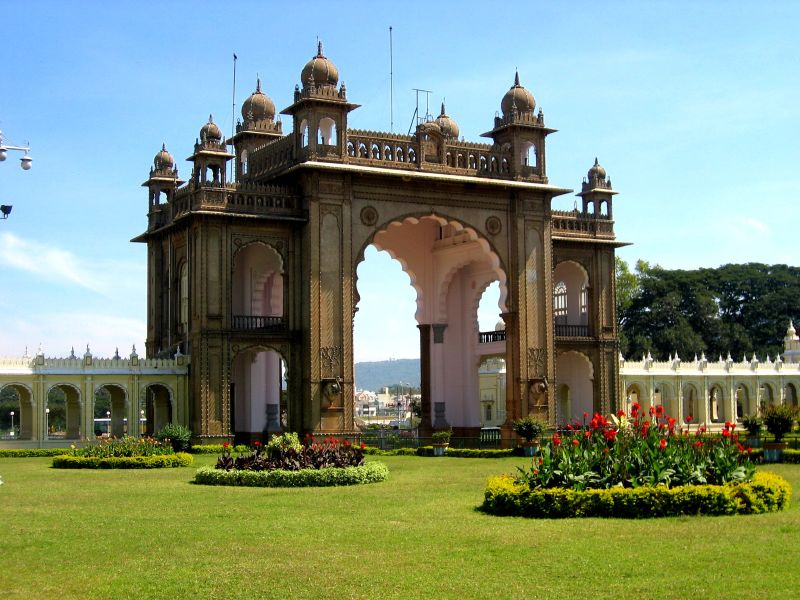
Mysore palace- This Maharaja's palace is one of the major sights of Mysore, built in in Indo-Saracenic style with turrets, domes, colonnades and arches.
This palace is a treasure house for Intricately carved rosewood doors, marble figurines, some ceilings with inlaid ivory work, collections of caskets, objects of personal use
and paintings of the members of the royal family, all exhibit such reality though age as worn them out a bit with slight discoloration.
The palace will be illuminated by by close to 100,000 bulbs on Sundays and National Holidays between 7PM-8PM, which is a breathtaking beauty.
Wodeyar's magnificent jewel studded golden throne is displayed here during the Dasara festival.
Brindavan Gardens:
Brindavan Gardens is one of the best among all the gardens in Karnataka, located at the KR Sagar Dam [Kannambadi].
Since 1960s, Brindavn has provided the backdrop for many Indian films and is spread over 150 acres.
The special attractions include the "Dancing Mountains" and in December 2004 the entire garden was restructured with new fountains and lights.
Visit timings:
Monday-Friday: 6:30 PM - 7:25 PM and
Saturday-Sunday: 6:30 PM - 8:25 PM
Chamundi Hills:
This can be reached by a 13km road from Mysore or by climbing 1000 steps laid out by the Mysore Maharaja in the 17th century from Mysore which is 800km above the
sea level.
The huge Nandi statue, a majestic 4.8 meter monolith on the mountain is also well known. At the top we can find 12th century temple of Chamundeshwari, the goddess of
the Wodeyars.
You can find the gigantic statue of the demon Mahishasura close to the temple.
St. Philomena's Church:
This is a beautiful Cathedral, reminiscent of medieval architectural style, one of the largest churches in the country.
This is built in the gothic style with stained glass windows and lofty towers with a very well built structure.
Mysore Zoo:
This was set up in nineteenth century under royal patronage. This includes exotic species which is housed with green surroundings. The zoo is famous for breeding very rare
animals.
Chamarajendra Zoological Gardens has emerged as one of the finest zoos in the country. The zoo has embarked on a new venture to set up a state-of-the-art Rescue and
Rehabilitation Centre.
The zoo has prepared to establish the centre for emergency mobile ambulance for the animals which was an Rs 5.5-crore plan and forwarded the same to the Central Zoo
Authority (CZA) for approval.
If it gets approved then this would be the first zoo to have an emergency mobile service to rescue animals fighting for life and cater to animals in and around Brahmagiri,
Madikeri, Bandipur, Kanakapura and other wildlife sanctuaries.
The Art Gallery
In 1875, the Jaganmohan Palace was converted into an art gallery and exhibits paintings that dates back to that period.
The artists of that time used mineral dyes and natural vegetable. The famous paintings of traditional Mysore 'gold leaf' are also exhibited in the gallery.
There are also paintings of contemporary artist like Raja Ravi Varma and Svetoslav Roerich.
Daria Daulat Bagh:
This is Tippu's Summer Palace built in 1784 is located here which is made of teak includes Indo-Sarcenic structure has beautiful frescos and ornate.
It has now become a museum and tells Tipu's valor and his losing battle against the British.
Best Time to Visit: September to April
How to get there:
Mysore is well connected by road to Madras, Bangalore, Coimbatore, Mangalore, Cannaore, Ooty, Calicut and Panaji (Goa).
Nearest airport: Bangalore
Nearest Railway Station : Mysore
By Road: Bangalore-Mysore highway
Here this post is going to deal with 'how to go to Wayandu from Bangalore?'...
First of all, How you are going to travel, by bus or in a private vehicle. The answer of this question is very important.
The simplest way is to select a Kerala or karnataka State RTC bus. One should book your ticket to Sulthan Bathery, Mananthavady or Kalpatta. Both State RTC have Super fast, Sleeper A/C, luxury buses. Better you select a A/C Rajahamsa or any Sleeper coach. One can select the cheeper Super fast buses, but for the less in fair will give you a back pain, surely if your not experienced in those buses.
Now If you are going by a Car, there are mainly 3 routes to Wayanadu from Bangalore. Before starting your journey one should be very much aware of where to go and what to do, to avoid extra travel cost. Because the enroute to Wayanadu one will more interesting tourist places to enjoy the journey.

In an era of unlimited information, the ability to filter for quality insights and reliable data is more important than ever for curious minds. In the fast-paced world of digital entertainment and sports analytics, having access to cutting-edge tools like cbtf exchange 247 ensures that you never miss a beat during the live action.
ReplyDelete